
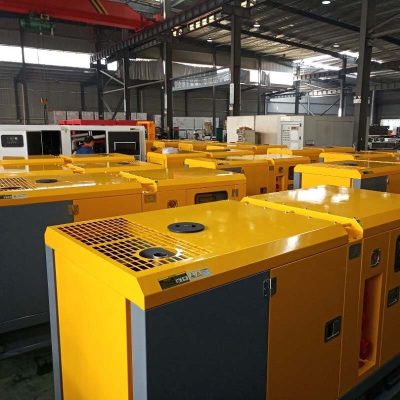
A diesel generator (also known as a diesel genset) combines a diesel engine with an electric generator (often a dynamo) to produce electrical energy. It is a special case of the engine generator that converts the mechanical energy obtained from the external source by creating movement and generating an electric charge in the coils in the electric circuit, into electricity as the output of the system and prevents interrupting daily activities or disrupting operations. A diesel compression ignition engine is usually designed to run on diesel fuel, but some types are adapted for other liquid fuels or natural gas (CNG). Diesel generators are used in off-grid locations or as an emergency power source in case of grid failure, as well as for more complex applications such as off-peak, grid support, and export to the grid.
Choosing the best home and industrial emergency power generator is a complex task and requires accurate calculation operations and should be done by the relevant expert in order to get the most efficiency for the consumer by spending the most reasonable cost.
The output power of generators can be three-phase and single-phase. Single-phase electricity is used in small applications such as household purposes, but three-phase generators are used in semi-industrial, industrial and power plant applications.
There are two types of generators. The first type is coal, which is not desired by customers today due to the need for constant replacement of coal, and the second type, which are called excitery or brushless, are stimulated by voltage induction. The mechanism of the generator can be understood by understanding the work of the water pump; The pump makes water flow, but it doesn’t really create water, only water flows.
Generators are actually available in three types: DC, synchronous and asynchronous. In synchronous generators, the speed of the generated magnetic field is equal to the speed of the rotor, even under load, which is mostly used to produce three-phase generators. If in asynchronous generators, the speed of the generated magnetic field is not equal to the rotation speed of the rotor; This is the case in the manufacture of electric motors.
The main part of this device is alternator and combustion engine; Because the electric current is produced by the alternator and the combustion engine provides the mechanical power.
Diesel Generator Set
The packaged combination of the diesel engine, generator and various peripherals (such as stand, canopy, sound attenuation, control systems, circuit breaker, jacket water heater and starting system) is referred to as a “generator set” or genset for short.
Set sizes from 8 to 30 kW are used for homes, small shops and offices, with larger industrial generators also from 8 to 2000 kW for office complexes, factories and other industrial facilities.
A 2,000 kW set can be housed in a 40-foot (12 m) container with a fuel tank, controls, power distribution equipment, and other equipment required for operation, either as a stand-alone power plant or as standby backup for grid power. These units, called Power Modules, are generators on large three-axle trailers weighing 85,000 pounds (38,555 kg) or more. Combinations of these modules are used for small power plants and may use one to 20 units per power section, these sections can be combined to engage hundreds of power modules. In these larger sizes, the power module (motor and generator) is brought to site separately on trailers and connected by large cables and a control cable to form a complete coordinated power plant. There are also a number of options to suit specific needs, including control panels for AutoStart and Mains Paralleling, acoustic canopies for fixed or mobile applications, ventilation equipment, fuel supply systems, exhaust systems and more.
Also, ships often have diesel generators that not only provide auxiliary power for lights, fans, winches, etc., but are also indirectly used for main propulsion. With electric propulsion, generators can be placed in a convenient position to provide more cargo transportation. Electric propulsion for ships was developed before World War I. Electric propulsion was featured on many warships built during World War II; Because the production capacity for large reduction gears was lacking compared to the production capacity of electrical equipment. Such a diesel-electric arrangement is also used in some very large ground vehicles such as railway locomotives.
The use of electricity generators
With the progress of the industry, the application of generators became more widespread, so that today, in addition to military places, they can be used in household electricity storage, medical equipment support, emergency power system of various places, laboratories, data centers, telecommunication equipment, commercial and recreational ships. , found commercial, administrative and industrial places. Normally, a diesel generator can work for eight hours, but by using 70% of its nominal power, the diesel generator can be used continuously.
Choosing a home power generator
When choosing generators, you should pay attention to several points:
The geographical location of the place where the generator is to be installed.
Type and amount of access to energy resources and fuel
Type of power consumption
power on time
The type of sensitivity of the device to the equipment in a place
And finally, the amount that is intended for the purchase of a home power generator.
Advantages and disadvantages of electricity generator
The advantages of this system are:
They have a long lifespan.
They use cheap fuel.
It has few risks for the consumer.
But the disadvantages of the home electricity generator include the following options:
Diesel engine and its parts are expensive.
The fueling system of this device is also expensive and sensitive.
The engine building is large and takes up a lot of space.
Places to use diesel generator
The electricity generator can be used in home applications such as providing electricity for the use of electrical appliances such as: TV, refrigerator, electric drill, etc., to large industrial applications such as: Power supply of steel production factories, hospitals, water turbines and power supply of mines and other power plant uses.
The use of diesel generator depends on the extent of use of all the places and tools that are provided for the use of electricity in human life. From the emergency need for electricity during a grid outage to sea, air, rail transportation and all the needs that exist in places without access to the electricity grid, all of them are considered applications of diesel generators.
The reason for the cost-effectiveness of using diesel generators
Sometimes, the exponential increase in the cost of electricity consumption in some industrial equipment and machinery increases to such an extent that it is not cost-effective to continue the process of providing electrical energy for that system. Therefore, the use of diesel generators due to the cheapness and availability of diesel fuel, as well as the ease of maintenance and supply of its parts compared to gas generators, leads to the selection and preference of generators with diesel fuel for supplying electricity to production and industrial equipment.
On the other hand, as mentioned earlier, the lack of access to the power grid in remote places or work projects outside the reach of the power grid, as well as transportation requirements, make the diesel generator the only possible option for working in certain conditions.
The reason why diesel generators are more popular than gas generators
In choosing and buying a generator, several factors such as: Fuel supply and its storage, working conditions, load supply and various other factors such as the price of the generator are influential. One of the reasons for the superiority of diesel generators over gas-burning types is the greater number of spare parts suppliers, the lack of knowledge and experience required for use and maintenance, as well as its simple handling and operation.
In examining the difference between a diesel generator and a gas generator, we come to the conclusion that due to the ease of the manufacturing process, as well as the simpler and slower working of different parts of the diesel generator, their parts suffer less depreciation.
Excessive use of any type of power generating device without respecting the shutdown times of the device will reduce the life of the parts over time. The gas generator has a much higher initial cost than the purchase. Even despite the easy supply of gas fuel in urban and domestic uses, diesel generators still have more fans. Normally, using diesel is the best solution for emergency or permanent electricity consumers when there is no access to the city electricity network.
Generator size
Generator sets are selected based on the electrical load intended to be supplied, electrical load characteristics such as kW, kVA, var, harmonic content, ripple currents (eg, motor starting current) and non-linear loads. The expected duty (such as emergency, prime, or continuous power), as well as environmental conditions (such as altitude, temperature, and emissions regulations) must also be considered.
Most manufacturers of larger generator sets offer software that performs complex sizing calculations by inputting site conditions and the characteristics of the connected electrical load.
Diesel generator fuel consumption
There are various parameters that affect the fuel consumption of the diesel generator. In general, the amount of diesel generator consumption usually depends on parameters such as the size of the diesel generator and the amount of load on it, and based on this, its approximate consumption can be obtained.
Diesel generator consumption is on average between 190 and 220 liters of diesel per hour per kilowatt. This amount varies according to the height above sea level, ambient temperature, relative humidity of the environment, age of the diesel generator and of course the quality of diesel used.
Power plants – electrical “island” mode
One or more diesel generators that operate without being connected to the grid are referred to as operating in island mode. Parallel operation of generators can provide the advantage of redundancy and better efficiency at partial loads. This power plant brings the generator sets online and takes them offline depending on the system’s needs at a given time. An island power plant intended for the primary power source of an isolated set often has at least three diesel generators, each of which is rated to carry the required load. Groups of up to 20 are not uncommon.
Generators can be electrically connected through a synchronization process. Synchronization involves matching the voltage, frequency and phase before connecting the generator to the system. Failure to synchronize before connection can cause high short-circuit current or wear of the generator or its switchgear. The synchronization process can be performed automatically by an automated synchronization module or manually by a trained operator. The auto synchronizer reads the voltage, frequency and phase parameters from the generator and busbar voltages while adjusting the speed via the engine governor or ECM (Engine Control Module).
The load can be shared between parallel-running generators through load sharing. Load sharing can be achieved using droop speed control, which is controlled by the frequency in the generator; while continuously adjusting the engine fuel control to shift the load to the remaining power sources. A diesel generator takes more load when fuel to its combustion system increases, while the load is released when fuel supply decreases.
When choosing generators, you should pay attention to several points:
The geographical location of the place where the generator is to be installed.
Type and amount of access to energy resources and fuel
Type of power consumption
power on time
The type of sensitivity of the device to the equipment in a place
And finally, the amount that is intended for the purchase of a home power generator.
The advantages of this system are:
They use cheap fuel.
It has few risks for the consumer.
The engine building is large and takes up a lot of space.
The electricity generator can be used in home applications such as providing electricity for the use of electrical appliances such as: TV, refrigerator, electric drill, etc., to large industrial applications such as: Power supply of steel production factories, hospitals, water turbines and power supply of mines and other power plant uses.
Sometimes, the exponential increase in the cost of electricity consumption in some industrial equipment and machinery increases to such an extent that it is not cost-effective to continue the process of providing electrical energy for that system. Therefore, the use of diesel generators due to the cheapness and availability of diesel fuel, as well as the ease of maintenance and supply of its parts compared to gas generators, leads to the selection and preference of generators with diesel fuel for supplying electricity to production and industrial equipment.
In choosing and buying a generator, several factors such as: Fuel supply and its storage, working conditions, load supply and various other factors such as the price of the generator are influential. One of the reasons for the superiority of diesel generators over gas-burning types is the greater number of spare parts suppliers, the lack of knowledge and experience required for use and maintenance, as well as its simple handling and operation.
Generator sets are selected based on the electrical load intended to be supplied, electrical load characteristics such as kW, kVA, var, harmonic content, ripple currents (eg, motor starting current) and non-linear loads. The expected duty (such as emergency, prime, or continuous power), as well as environmental conditions (such as altitude, temperature, and emissions regulations) must also be considered.
There are various parameters that affect the fuel consumption of the diesel generator. In general, the amount of diesel generator consumption usually depends on parameters such as the size of the diesel generator and the amount of load on it, and based on this, its approximate consumption can be obtained.
One or more diesel generators that operate without being connected to the grid are referred to as operating in island mode. Parallel operation of generators can provide the advantage of redundancy and better efficiency at partial loads. This power plant brings the generator sets online and takes them offline depending on the system’s needs at a given time. An island power plant intended for the primary power source of an isolated set often has at least three diesel generators, each of which is rated to carry the required load. Groups of up to 20 are not uncommon.


